
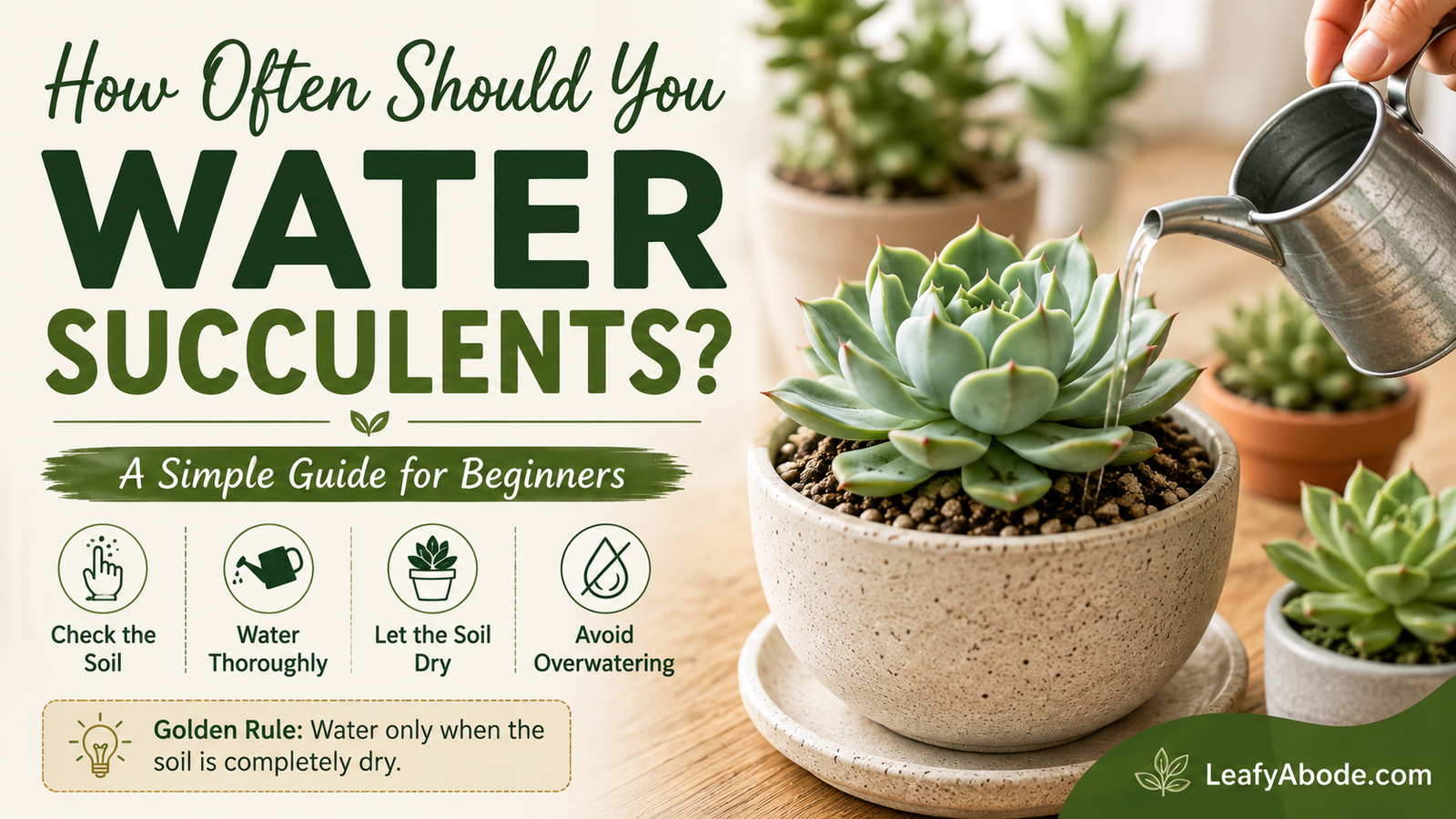
How Often Should You Water Succulents? A Beginner’s Guide (2026)
If you’ve ever looked at a succulent and wondered, “Does it need water yet?”, you’re definitely not alone.
When I first started learning about indoor plants, watering seemed like one of the easiest parts of plant care. I assumed you simply gave a plant some water every week and moved on. Light affects how quickly your soil dries, so understanding how much light succulents need can help you develop a better watering routine.
Succulents quickly taught me that it isn’t quite that simple.
One week, a succulent may need water after several days. At another time, the same plant can go much longer without needing a drink. The amount of light it receives, the temperature inside your home, humidity, pot size, soil type, and even the season can all change how quickly the soil dries.
That’s why there isn’t one watering schedule that works for every succulent.
A better approach is to learn how to recognize when your plant actually needs water.
This is one of the most useful garden tips you can learn when you’re starting out with plants. Instead of treating watering plants like a fixed weekly chore, you’ll start paying attention to what your plant and its soil are telling you.
In this beginner-friendly guide, we’ll look at how often succulents generally need water, how to check the soil, how much water to give, what changes when you grow succulents indoors, and how to recognize the difference between an overwatered and underwatered plant.
If you’re also learning the basics of succulent care, you may want to read How to Care for Succulents for a broader look at light, soil, watering, and everyday care.
How Often Should You Water Succulents?
For most indoor succulents, the best approach is to water when the soil has dried out thoroughly rather than following a fixed schedule.
Depending on the conditions in your home, that might mean watering every week, every couple of weeks, or sometimes even less frequently.
There are several reasons for this variation.
A succulent sitting near a bright, warm window may use water much faster than the same type of plant sitting in a cooler room with less light.
The pot and soil also make a big difference. A succulent growing in a terracotta pot with a gritty, fast-draining mix may dry considerably faster than one planted in a plastic pot with moisture-retaining soil.
So instead of asking:
“Is it Sunday? Time to water?”
Try asking:
“Is the soil dry enough for my succulent to need water?”
That small change in thinking can make plant care much easier.
Why Succulents Don’t Need Frequent Watering
Succulents have a useful adaptation that makes them different from many leafy houseplants.
Their thick leaves, stems, or roots can store water. This allows many succulent plants to survive periods when water isn’t readily available.
That doesn’t mean succulents should be kept completely dry.
They still need water to grow, produce new leaves, and maintain healthy tissues. The important part is giving them enough water when they need it and allowing the soil to dry between waterings.
Constantly damp soil can create a much bigger problem than waiting another day or two.
When roots remain surrounded by excess moisture for too long, they have less access to oxygen and become more vulnerable to root problems.
This is one reason soil is such an important part of succulent plants care. If you’re unsure whether your soil drains properly, our guide to Best Soil for Succulents explains what to look for in a good succulent potting mix.
The Simplest Way to Know When Your Succulent Needs Water
You don’t need an expensive moisture meter to get started.
One of the easiest methods is to check the soil yourself.
Push your finger about an inch or two into the soil. If it feels completely dry at that depth, your succulent may be ready for water.
If it still feels cool and damp, wait.
For larger pots, checking only the surface can be misleading because the top layer often dries before the soil underneath.
You can also lift the pot if it’s small enough.
Over time, you’ll notice that a pot filled with dry soil feels considerably lighter than one containing moisture. This isn’t a perfect measurement, but it can become a useful habit once you become familiar with your plant.
This kind of observation is useful far beyond succulents. Whether you’re caring for houseplants or hoping to eventually grow a garden, learning to pay attention to soil moisture is one of those basic skills that makes plant care easier.
Don’t Rely Only on the Soil Surface
This is an easy mistake for beginners to make.
You look at the top of the pot and see dry soil, so you assume the entire root zone is dry.
But the surface is usually the first part of the soil to lose moisture.
The soil underneath may still be damp.
This is particularly common when:
- The pot is large.
- The plant receives little light.
- Your home is humid.
- The soil contains lots of moisture-retaining material.
- You’re using a plastic container.
That’s why checking deeper into the pot gives you a better idea of what’s happening around the roots.
And this is an important lesson for beginners in general: don’t judge plant health by one thing alone. Good plant care comes from looking at the whole picture—soil, light, watering, pot size, temperature, and the plant itself.
How Much Water Does a Succulent Need?
When your succulent does need water, don’t just give it a tiny splash.
For most established potted succulents, it’s better to water thoroughly until excess water begins flowing from the drainage hole.
This helps moisten the entire root zone rather than leaving only the top layer wet.
Once the excess water has drained away, empty any water sitting in the saucer or decorative outer container.
The goal isn’t to keep the soil slightly wet all the time.
Instead, think of the process like this:
Water thoroughly → allow the soil to dry → water again.
This pattern is generally more useful than giving your succulent a small amount of water every few days.
Why Small Sips of Water Can Be a Problem
Imagine pouring a glass of water into a dry sponge.
If you only add a few drops to one area, some parts of the sponge remain dry.
Something similar can happen in a pot when you repeatedly give a succulent tiny amounts of water.
The upper part of the soil may become damp while the deeper root zone remains dry.
A thorough watering followed by an appropriate drying period is usually a better approach for established succulents growing in containers with good drainage.
This is one of those simple garden tips that applies beyond succulent care too. Different plants have different watering needs, but understanding how moisture moves through the soil is useful whether you’re caring for a few pots at home or eventually planning to plant a garden.
The Pot Matters More Than You Might Think
Two identical succulents can have completely different watering needs simply because they’re growing in different pots.
Terracotta Pots
Terracotta is porous and can allow some moisture to evaporate through the sides.
This can help the soil dry faster.
For beginners who sometimes worry about overwatering, terracotta can be a practical choice.
Plastic Pots
Plastic doesn’t allow moisture to evaporate through the sides, so soil can stay wet longer.
That doesn’t make plastic pots bad for succulents. It simply means you’ll need to pay closer attention to how quickly the soil dries.
Ceramic Pots
Ceramic pots can work well too, particularly when they have a drainage hole.
Glazed ceramic generally retains moisture more than unglazed terracotta, so the soil may take longer to dry.
If you’re choosing a new container, our upcoming guide on Best Pots for Succulents (link after publishing) will compare different pot materials and sizes.
The Soil Changes Everything
You can have excellent watering habits and still run into problems if the soil holds too much moisture.
A dense, moisture-retaining mix can stay wet for a long time.
A loose, gritty succulent mix can dry much faster.
That’s why watering frequency can’t really be separated from soil choice.
If you’ve recently changed your potting mix, don’t automatically continue using exactly the same watering routine. Observe how quickly the new mix dries and adjust accordingly.
If you haven’t read it yet, Best Soil for Succulents explains how different soil ingredients affect drainage and why the right growing medium matters so much for indoor succulents.
What About Newly Propagated Succulents?
Newly propagated succulents need a little more care.
A fresh leaf or stem cutting may not have a developed root system yet, which means it can’t use water in the same way as an established plant.
If you’re propagating succulents, avoid treating a fresh cutting like a mature plant.
Our guide on How to Propagate Succulents explains the different propagation methods and what to expect while roots are developing.
The most important thing is patience.
Giving a cutting lots of water doesn’t make roots appear faster.
In fact, excess moisture can cause the cutting to rot before it has a chance to establish itself.
If you’ve recently moved a propagated succulent into its own container, How to Repot Succulents can also help you understand how to handle the transition into fresh soil.
A Simple Rule for Beginners
If all of this feels like a lot of information, remember one thing:
Don’t water your succulent because the calendar says it’s time. Check the soil and the plant first.
Your home is different from someone else’s home.
Your pot is different.
Your soil is different.
Your light is different.
Your climate is different.
So your watering routine will naturally be different too.
That’s not a problem. It’s actually why learning to observe your plants is more useful than memorizing a fixed schedule.
And that is really the heart of good plant care.
You don’t need to know everything before you start. Whether you’re looking after a few indoor plants, exploring the best plants for beginners, or dreaming about the day you can grow a garden, learning to observe your plants is one of the most valuable skills you can develop.
At Leafy Abode, we’re taking the same approach—learning about indoor plants step by step and turning that information into simple guides that beginners can actually use.

I am the creator of LeafyAbode, a platform dedicated to helping people grow and care for indoor plants with confidence. I share practical, easy-to-follow guides on plant care, home gardening, and creating a green living space. My content is based on research, real experience, and a passion for making plant care simple for beginners and enthusiasts alike.
Post Disclaimer
The information contained in this post is for general information purposes only. The information is provided by How Often to Water Succulents (Avoid Wrinkled & Soft Leaves) and while we endeavour to keep the information up to date and correct, we make no representations or warranties of any kind, express or implied, about the completeness, accuracy, reliability, suitability or availability with respect to the website or the information, products, services, or related graphics contained on the post for any purpose.
1 thought on “How Often to Water Succulents (Avoid Wrinkled & Soft Leaves)”