
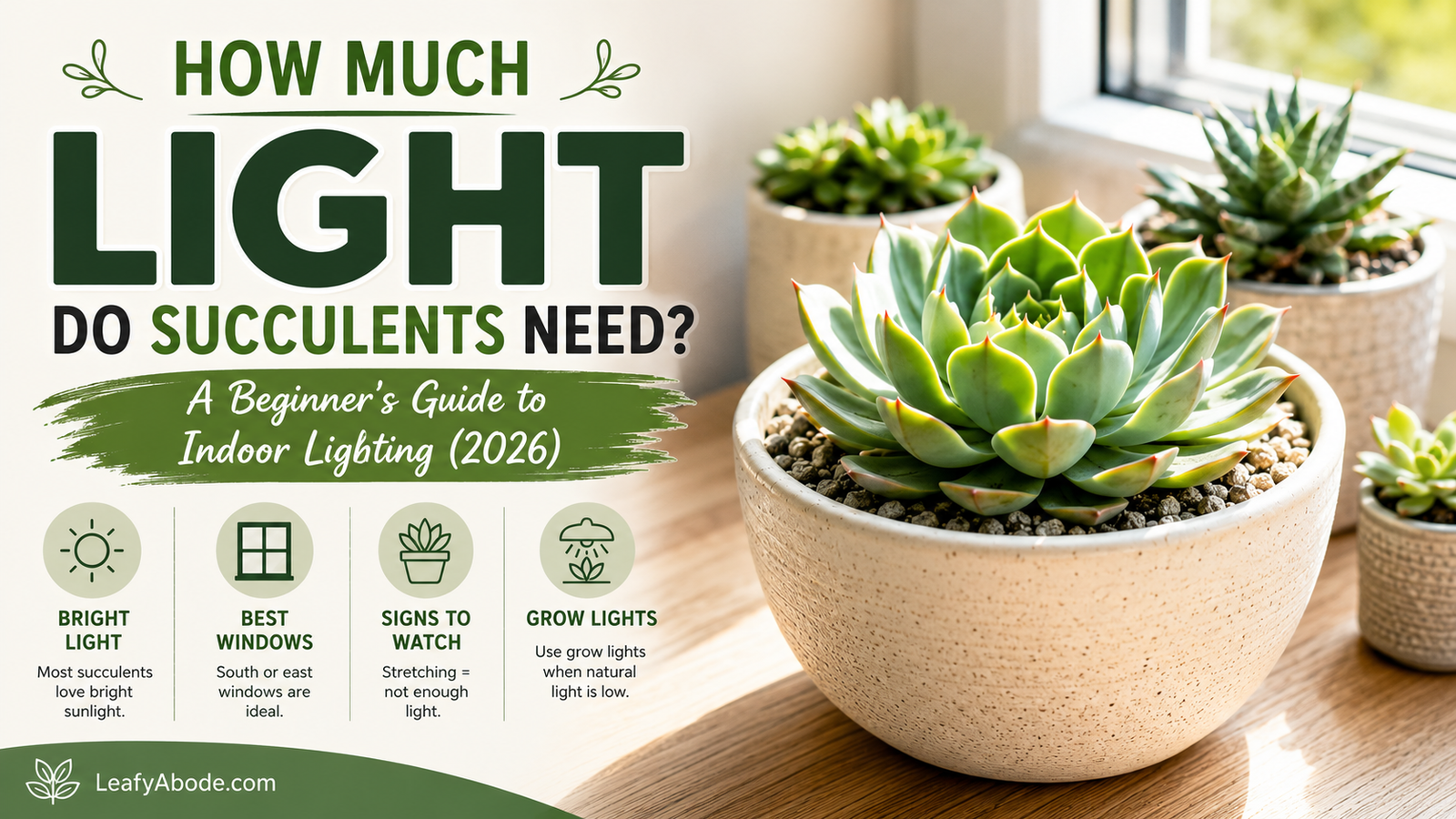
How Much Light Do Succulents Need? A Beginner’s Guide to Indoor Lighting (2026)
If you’ve ever bought a beautiful succulent, placed it somewhere that looked perfect, and then noticed it slowly leaning toward a window, you’re probably wondering what went wrong.
This is one of those things that can be confusing when you’re new to indoor plants. The room may look bright to you, but what feels bright to our eyes isn’t necessarily enough light for a succulent.
Light is one of the biggest factors in successful succulent care. It affects how the plant grows, how compact its leaves remain, and even how much water it uses.
The good news is that you don’t need a professional greenhouse or a house full of enormous windows to grow healthy succulents indoors. You mainly need to understand what “bright light” actually means and learn to recognize when your plant is getting too little or too much.
In this guide, we’ll look at how much light succulents need indoors, where to place them, what happens when they don’t get enough light, how to recognize sun stress, and what you can do if your home doesn’t have a naturally bright spot.
If you’re still learning the basics of How to Care for Succulents, think of lighting as one part of a bigger picture. Soil, watering, temperature, and the type of succulent all work together.
How Much Light Do Succulents Need?
Most succulents prefer bright light, and many varieties can handle several hours of direct sunlight once they have adapted to it.
However, saying “give your succulent lots of sunlight” isn’t quite enough.
The amount of light a plant receives depends on where you live, which direction your window faces, the season, whether anything blocks the window, and the particular succulent you’re growing.
A succulent sitting directly beside a bright south-facing window may receive dramatically more light than one placed several feet away from a north-facing window.
That’s why there isn’t one perfect number of hours that applies to every succulent.
For a beginner, a better starting point is this:
Give your succulent the brightest suitable location you can provide, then watch how the plant responds.
If it remains compact and grows normally, your location may be working well. If it starts stretching toward the window, the plant is probably asking for more light.
What Does “Bright Light” Actually Mean?
This is where indoor plant advice can become confusing.
When someone says a plant needs “bright light,” they don’t necessarily mean that it must sit directly in harsh sunlight all day.
Bright light can mean a location close to a sunny window where the plant receives plenty of natural illumination.
For many indoor succulents, a spot near a bright window is a good starting point.
But there’s an important difference between bright indirect light and direct sunlight.
Bright indirect light means the area receives lots of natural light, but the sun’s rays aren’t constantly hitting the leaves.
Direct sunlight means sunlight reaches the plant’s leaves without being filtered through curtains, blinds, or another barrier.
Some succulents tolerate or even prefer several hours of direct sun. Others can become stressed if they’re suddenly moved from a low-light location into intense sunlight.
So don’t assume that more sunlight is automatically better.
The Best Window for Succulents
The direction of your window can make a noticeable difference.
South-Facing Windows
In many homes, south-facing windows can provide some of the brightest indoor light throughout the day.
This can be an excellent location for sun-loving succulents.
However, very strong sunlight through glass can become intense, particularly during hot periods. Watch your plant rather than assuming the location will always be perfect.
West-Facing Windows
West-facing windows often receive strong afternoon light.
This can work well for many succulents, but afternoon sunlight can also be intense, especially during summer.
If you notice signs of sun stress, moving the plant slightly farther from the glass or using a sheer curtain can help.
East-Facing Windows
East-facing windows generally provide gentler morning sunlight.
This can be a comfortable option for many indoor succulents, particularly if you’re concerned about exposing a plant to intense afternoon sun.
North-Facing Windows
North-facing windows often provide less direct sunlight, depending on your location and surroundings.
Some succulents may struggle if they’re placed too far from this type of window.
That doesn’t mean you can’t grow succulents in a room with a north-facing window. You may simply need to place the plant closer to the window or consider supplemental lighting.
How Can You Tell If a Succulent Isn’t Getting Enough Light?
Your succulent can’t exactly tell you, “I need a brighter window.”
Instead, it communicates through changes in its growth.
One of the most noticeable signs is stretching.
You may notice the leaves becoming farther apart, the stem growing unusually long, or the entire plant leaning toward the nearest source of light.
This is often called etiolation.
A healthy succulent typically has a relatively compact appearance. When light is insufficient, the plant may stretch in an attempt to reach more light.
Other Signs of Low Light
Depending on the variety, you might notice:
- New growth becoming thinner.
- Leaves appearing farther apart.
- The plant leaning toward a window.
- Slower growth.
- Loss of some of the plant’s normal shape or colour.
- New growth becoming unusually pale.
One important point: not every change in a succulent means low light.
Watering problems, root issues, temperature changes, and natural seasonal growth can also affect appearance.
That’s why it’s better to look at several signs together rather than diagnosing a plant based on one symptom.
What Should You Do If Your Succulent Is Stretching?
If your succulent has become noticeably leggy, moving it closer to a brighter window may help prevent further stretching.
However, don’t make a dramatic change overnight.
A succulent that has been growing in relatively low light can become stressed if you suddenly expose it to several hours of intense direct sunlight.
Instead, increase its light gradually.
For example, you could move it closer to a bright window first and observe how it responds. If you’re introducing direct sunlight, gradually increasing exposure gives the plant time to adjust.
Unfortunately, already-stretched growth usually won’t become compact again.
The plant may continue growing more normally from that point onward, but the stretched portion won’t simply shrink back.
This is one reason catching low-light problems early is helpful.
Can Succulents Get Too Much Sun?
Yes.
It’s easy to hear that succulents love sunlight and conclude that they should be placed in the strongest possible sun.
That’s not always the case.
A succulent that isn’t accustomed to intense direct sunlight can develop sun stress or even sunburn when exposed too quickly.
Possible signs include:
- Brown or bleached patches.
- Pale or yellowish areas.
- Dry, damaged sections of leaves.
- Scorched-looking tissue.
The exact appearance varies between species.
If you notice sudden damage after moving a succulent into stronger sunlight, consider whether the transition was too fast.
You can move the plant slightly farther from the window or filter the strongest sunlight with a sheer curtain.
Do Succulents Need Direct Sunlight?
Not every succulent needs the same amount of direct sun.
Some varieties are much more tolerant of strong sunlight than others.
Aloe vera, many types of Echeveria, and some other sun-loving succulents can appreciate substantial light when properly acclimated.
Haworthia, on the other hand, generally prefers bright light but can be more sensitive to intense direct sunlight.
This is why identifying the actual plant you own can make succulent care much easier.
If you buy a plant without knowing its variety, take some time to identify it. Once you know what you’re growing, you can research its natural growing conditions and adjust your indoor setup accordingly.
How Far Should a Succulent Be From a Window?
There’s no universal distance that works for every home.
A succulent might thrive right beside one window but struggle several feet away from another.
Glass doesn’t automatically mean that a plant receives enough usable light.
Window size, direction, curtains, nearby buildings, trees, weather, and the season all affect the amount of light entering your room.
As a practical starting point, place your succulent relatively close to your brightest suitable window and observe it.
If the plant starts leaning or stretching, move it closer or provide additional light.
If you notice signs of sun stress, reduce the intensity gradually.
Your plant’s response is useful information.
What About Succulents in Dark Rooms?
This is where expectations matter.
A room that feels comfortable and bright enough for reading may still be relatively low-light for a succulent.
If your room receives very little natural light, a succulent may survive for a while but eventually show signs of insufficient light.
That doesn’t mean you have to give up on growing plants in that room.
A grow light can provide supplemental light when natural sunlight isn’t sufficient.
For someone just starting out, you don’t necessarily need an elaborate setup. A suitable grow light positioned correctly can make indoor growing possible even in rooms without ideal windows.
The important thing is to choose a light designed for plant growth rather than assuming any ordinary household bulb will provide everything a succulent needs.
Do Succulents Need Grow Lights?
Not necessarily.
If your home already provides enough natural light, you may never need one.
Grow lights become particularly useful when:
- Your home has very little natural light.
- Your windows face a direction that provides limited sunlight.
- Nearby buildings or trees block sunlight.
- You want to keep succulents farther from windows.
- Winter conditions significantly reduce available natural light.
If you do use a grow light, follow the manufacturer’s recommendations for distance and operating time rather than assuming that leaving it on all day will produce better results.
Plants need periods of darkness too.
Light and Watering Are Connected
Here’s something beginners sometimes overlook: light affects watering.
A succulent receiving strong light may dry out faster than one sitting in a dim room.
That doesn’t mean you should automatically water a sunny succulent every few days.
Instead, check the soil.
This is why our guide on How Often Should You Water Succulents? is an important companion to this article. Your watering routine should respond to how quickly the soil is drying, rather than simply following a fixed calendar.
Likewise, if you’ve changed the plant’s location, pay attention to whether its soil is drying faster or slower than before.
What Happens When You Move a Succulent to More Light?
If you’ve discovered that your succulent isn’t receiving enough light, it’s tempting to immediately put it in the sunniest spot available.
Try not to make such a sudden change.
A plant that has adapted to lower light can be sensitive to intense sunlight.
Instead, increase exposure gradually.
Start with bright indirect light and then introduce more direct sunlight over time if the variety can tolerate it.
Think of it as helping your succulent adjust rather than forcing it to adapt overnight.
This gradual approach is particularly important if you’ve moved a plant from an indoor shelf to a sunny balcony or outdoor area.
Rotate Your Succulent Occasionally
Have you noticed your succulent leaning toward the window?
If so, it may simply be growing toward the strongest available light.
Rotating the pot occasionally can help the plant receive light from different directions and may encourage more even growth.
You don’t need to rotate it every day.
A simple occasional turn is enough.
Just remember that rotating the plant won’t solve a serious low-light problem. If it’s stretching significantly, it needs more usable light rather than simply being turned around.
Light Requirements Can Change With the Seasons
Your succulent’s indoor environment isn’t exactly the same throughout the year.
During brighter months, a window may provide plenty of light.
During darker months, shorter days, cloudy weather, or a lower sun angle can reduce the amount of usable light reaching your plant.
You may notice slower growth during these periods, which isn’t necessarily a problem.
The important thing is to continue observing your plant.
If a succulent that was previously healthy begins stretching during winter, consider whether its available light has changed.
This is also a good time to be cautious with watering. If the plant is receiving less light and growing more slowly, the soil may take longer to dry.
A Simple Light Check for Beginners
If you’re unsure whether your succulent is getting enough light, don’t overcomplicate it.
Ask yourself:
Is the plant growing compactly?
If yes, that’s encouraging.
Is it leaning strongly toward one direction?
It may be searching for more light.
Are new leaves becoming unusually far apart?
Low light could be contributing.
Are the leaves developing bleached or scorched patches after a sudden move into strong sunlight?
The plant may be receiving too much intense light too quickly.
These aren’t perfect diagnostic rules, but they’re useful starting points.
The more you observe your plants, the easier it becomes to understand their normal appearance.
How Light Fits Into Overall Succulent Care
Good succulent care isn’t about finding one perfect window and forgetting about the plant.
It’s about creating a balance.
Your succulent needs suitable light, well-draining soil, appropriate watering, and a container that allows excess moisture to escape.
If one part changes, another part may need to change with it.
For example, moving a succulent into brighter light can increase how quickly the soil dries. Repotting it into a different soil mix can also change its watering needs.
That’s why I prefer thinking about plant care as a series of small observations rather than a strict list of rules.
You don’t have to become an expert overnight.
Start with one plant.
Watch how it grows.
Notice how quickly its soil dries.
Pay attention to the colour and shape of its new growth.
Over time, these small observations will tell you much more than a fixed schedule ever could.
Frequently Asked Questions
How many hours of sunlight do succulents need?
Many succulents grow well with several hours of bright light each day, and some can tolerate several hours of direct sunlight after acclimation. The exact requirement varies by species and indoor conditions, so watch the plant’s growth rather than relying only on a fixed number of hours.
Can succulents grow in low light?
Some succulents tolerate lower-light conditions better than others, but most will grow more strongly and maintain better form with bright light. Prolonged low light can cause stretching, leaning, and weaker growth.
Can succulents get too much sunlight?
Yes. Succulents that are suddenly exposed to intense direct sunlight can develop sunburn or other signs of stress. Gradually acclimating a plant to stronger light can help reduce this risk.
Is a south-facing window good for succulents?
A south-facing window can provide excellent light for many succulents, depending on your location and the amount of sunlight reaching the window. During periods of intense sunlight, monitor the plant for signs of stress.
What should I do if my succulent is growing tall and thin?
A tall, stretched appearance is often a sign that the plant isn’t receiving enough light. Move it gradually toward a brighter location rather than immediately exposing it to strong direct sunlight.
Do succulents need a grow light indoors?
Not always. If your succulent receives sufficient natural light, a grow light may not be necessary. Supplemental lighting can be useful when natural light is limited.
Final Thoughts
Learning how much light your succulent needs doesn’t have to involve complicated measurements or expensive equipment.
Start with the brightest suitable location in your home, observe how your plant responds, and make changes gradually.
If your succulent stays compact and produces healthy new growth, you’ve probably found a good spot.
If it starts stretching toward a window, it may be asking for more light.
And if it develops scorched or bleached patches after being moved into strong sunlight, it may need a gentler transition.
That’s one of the things I like most about learning indoor plant care: you don’t have to know everything before you begin.
You can learn by observing one plant at a time.
If you’re building your succulent collection, keep this guide alongside Best Soil for Succulents, How Often Should You Water Succulents?, How to Propagate Succulents, and How to Repot Succulents. Together, these guides cover some of the most important parts of keeping succulents healthy indoors.
And if your plant isn’t looking quite right, don’t immediately assume you’ve failed.
Sometimes the answer is simply that the plant needs a little more light, a little less water, or a better environment.
Give yourself—and your plants—time to learn.

I am the creator of LeafyAbode, a platform dedicated to helping people grow and care for indoor plants with confidence. I share practical, easy-to-follow guides on plant care, home gardening, and creating a green living space. My content is based on research, real experience, and a passion for making plant care simple for beginners and enthusiasts alike.
Post Disclaimer
The information contained in this post is for general information purposes only. The information is provided by Indoor Succulent Light Requirements: Stop Leggy & Leaning Growth and while we endeavour to keep the information up to date and correct, we make no representations or warranties of any kind, express or implied, about the completeness, accuracy, reliability, suitability or availability with respect to the website or the information, products, services, or related graphics contained on the post for any purpose.
3 thoughts on “Indoor Succulent Light Requirements: Stop Leggy & Leaning Growth”